
Why did my garage floor heave this winter in Marshfield?
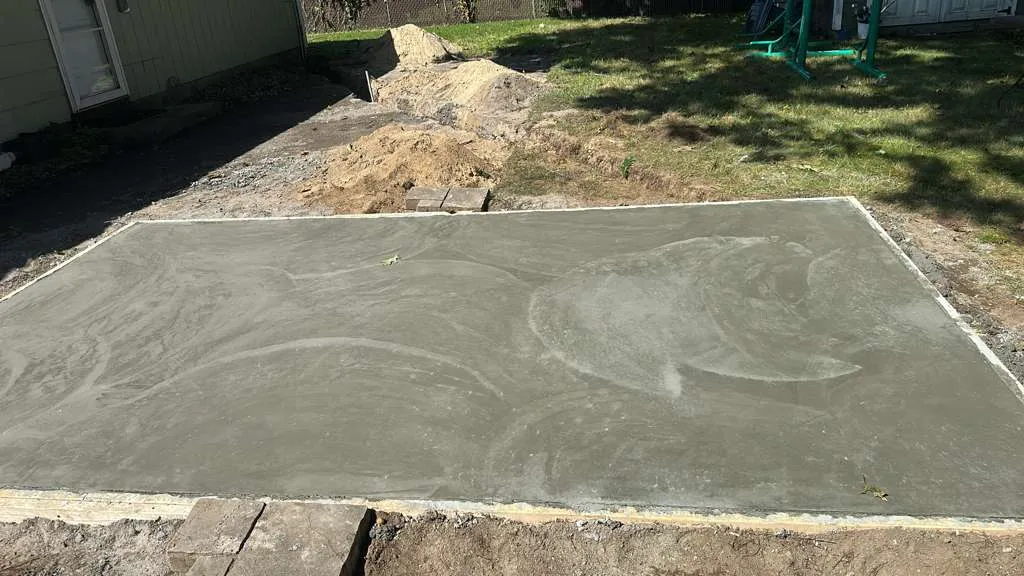
If your garage floor in Marshfield has a new bump at the door, a crack that opened up over the winter, or an overhead door that suddenly will not close flat, the slab has probably heaved. It is one of the most common winter garage problems we see near the coast, and the fix is rarely just concrete. Before any garage slab repair makes sense, you need to know why the ground under the slab is moving.
What makes a garage floor heave in winter?
Frost heave needs three things at once: soil that holds water, enough water in it, and temperatures cold enough to freeze it. When wet soil under a slab freezes, ice lenses form and grow, and the ground expands upward, taking the concrete with it. When it thaws, the slab drops back, usually not quite to where it started.
Around Marshfield, the water part of that equation is often easy to find:
- High water table. Coastal and low-lying lots stay wet much of the year, so the soil under the garage is saturated going into winter.
- Driveway drainage. A driveway that pitches toward the garage sends rain and snowmelt straight under the door.
- Wrong pitch inside. A slab that slopes back toward the house holds meltwater instead of sending it out.
- Downspouts and roof runoff. Water dumped at the corners of the garage soaks the soil along the foundation.
- Poor base. Older slabs poured on silty fill instead of free-draining gravel hold water like a sponge.
Why doesn't patching the crack fix it?
Because the crack is the symptom. As long as wet soil keeps freezing under the slab, the floor will keep moving, and any rigid patch will crack again beside the old one. Resurfacing does not help either, since the overlay rides on top of the same moving slab. The repair order matters:
- Find where the water under the slab is coming from.
- Correct it: regrade or add a trench drain at the door, redirect downspouts, fix the pitch.
- Decide whether the existing slab can be kept and repaired, or needs to be replaced on a drained base.
When does the slab need to be replaced?
If the slab has heaved and settled for several winters, it is often cracked into sections and pitched the wrong way. At that point the lasting fix is a garage slab replacement: remove the old concrete, dig out the wet, frost-susceptible fill, install compacted crushed stone that drains, and pour new air-entrained concrete with control joints. The new floor is pitched toward the overhead door, which is what the Massachusetts residential code expects for garage floors.
If the movement is minor and the drainage can be corrected, the slab can sometimes stay, with the cracks repaired and the surface restored. Our guide on resurfacing versus replacing a cracked garage slab walks through how we make that call.
Can garage slab work be done in winter?
Yes. A garage is an enclosed space, so we can heat it and protect fresh concrete from freezing, which is the main risk with winter pours. Demolition and base work are not weather dependent inside the garage. Winter is also the easiest time to diagnose heave, because you can see exactly where the slab lifts. Once the floor is done, a garage floor coating keeps salt and meltwater from soaking in and starting the next round of damage.
When should you call a contractor?
Call when the heave is new, when the overhead door starts binding, or when cracks reopen every winter. Those are signs the problem is in the ground, not the surface. We offer a free on-site assessment in Marshfield where we look at the slab, the driveway and the drainage around the garage, and tell you whether a repair will hold or the slab needs to be replaced. If the floor is also flaking under the tires, see why garage floors flake and pit.
Fix the water first and the concrete repair lasts. Concrete Solutions & Waterproofing serves homeowners, condo associations and facility managers across Eastern Massachusetts, Rhode Island and Southern New Hampshire.
Key takeaways
- Garage floors heave when wet soil under the slab freezes and expands.
- Near the coast, high water tables, driveway runoff, downspouts and wrong slab pitch keep that soil wet.
- Patching or resurfacing a heaving slab fails because the slab keeps moving.
- The lasting fix corrects the drainage first, then repairs or replaces the slab on a compacted, free-draining base pitched toward the door.
- Garage slab work can be done in winter with heat and protection for the new concrete.