
Should you resurface or replace a cracked garage slab in Hanover?
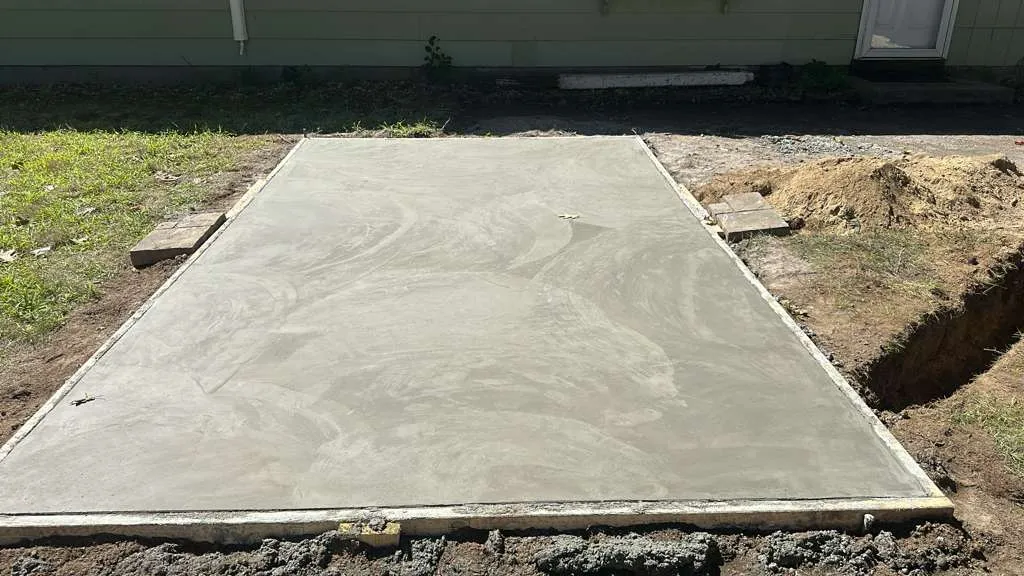
A cracked garage floor in Hanover raises one question before any other: can this be fixed on the surface, or does the slab have to come out? The answer changes the cost, the schedule and how long the fix lasts, so it is worth understanding how a contractor makes that call. Here is how we decide on garage slab repair versus replacement when we look at a floor.
Why do garage slabs crack in the first place?
Almost every concrete slab cracks a little as it cures and shrinks. Those hairline cracks are normal and usually harmless. The cracks that cause trouble come from movement underneath or water getting in:
- Settling base. Many older garage floors in Hanover and across the South Shore were poured on whatever fill was there, with little compaction. When that fill settles, the slab cracks and drops.
- Frost heave. Wet soil under the slab freezes and lifts it in winter, then lets it back down in spring. Over the years that cracks and tilts the floor, often at the door.
- Water and salt. Road salt and freeze-thaw break down the surface and open up existing cracks.
- Missing control joints. A slab with no joints cut into it will crack wherever it wants to.
When is resurfacing the right fix?
Resurfacing puts a new bonded wearing layer over the existing slab after the surface has been ground clean and the cracks repaired. It is the faster and less expensive option, and it works well when:
- The slab is still close to level and water drains toward the door.
- The cracks are not offset, meaning both sides sit at the same height.
- The cracks do not open and close with the seasons.
- The damage is in the top layer: scaling, pitting, stains and shallow spalls.
In that case we diamond-grind the floor, route and fill the cracks, patch the spalls, and install a polymer-modified overlay. Many homeowners then add an epoxy or polyaspartic floor coating to protect the new surface from road salt.
When does the slab need to be replaced?
If the slab itself is moving, resurfacing will not survive it. Any crack that is still moving comes straight back through a new overlay, usually within a winter or two. We recommend a full garage slab replacement when we see:
- Offset cracks, where one edge is higher than the other
- Sections that rock or sound hollow when tapped
- A floor that now pitches toward the house, or ponds water in the middle
- Heave at the door every winter
- Deep spalls exposing reinforcing steel
Replacement means breaking out the old concrete, digging out soft or wet fill, building and compacting a new gravel base, and pouring a new slab of air-entrained concrete with control joints. The new floor is pitched toward the overhead door. The Massachusetts residential code, based on the International Residential Code, calls for garage floors to slope toward a drain or the main vehicle door, which matters if the old slab never did.
How do you tell whether a crack is still moving?
This is the part that is hard to judge on your own, and it is the heart of the decision. A few clues help:
- Run your hand across the crack. If you feel a lip, it has moved.
- Watch it over a season. Cracks that widen in winter and close in summer are active.
- Look for fresh, clean edges or crumbling along the crack. Old dormant cracks are usually dirty and rounded.
A good contractor checks this directly, along with drainage around the garage and the condition of the base. If you are also seeing cracks in an attached foundation wall, it makes sense to look at concrete crack repair for those at the same visit.
What should you do next?
If you are on the fence, a free on-site assessment in Hanover will settle it. We check how the slab is behaving, where water goes, and how deep the damage runs, then give you a written estimate for the option that will actually last. Garage work is indoors, so it can be scheduled through the winter, with heat and protection for the new concrete as needed. If your floor is mostly flaking rather than cracking, our article on why garage floors flake and pit covers that problem in more depth.
The right choice is the one that matches what the slab is doing, not the one that is cheapest today. Concrete Solutions & Waterproofing serves homeowners, condo associations and facility managers across Eastern Massachusetts, Rhode Island and Southern New Hampshire.
Key takeaways
- Resurface when the slab is level, the cracks are not moving and the damage is at the surface.
- Replace when cracks are offset, sections rock or have sunk, water drains toward the house, or the floor heaves every winter.
- Resurfacing over a moving slab will crack again within a winter or two.
- A replacement slab should go on a compacted gravel base, use air-entrained concrete, and slope toward the overhead door.
- An on-site assessment checks movement, drainage and depth of damage before you spend money.