
Why does water come up through a basement floor in winter in Milton?
If you live in Milton and you have found a wet stripe along the edge of your basement floor after a January thaw, you are not alone. Water that shows up from below, rather than running down a wall, is one of the most common winter calls we get, and it is exactly the problem interior basement waterproofing is designed to solve. This article explains where that water comes from, why it shows up in winter, and what actually stops it.
Where does water under a basement floor come from?
Every basement floor sits on soil, and in much of Eastern Massachusetts that soil holds groundwater. Milton has plenty of homes built close to brooks, wetlands and the slopes running down toward the Neponset River, and many sit on dense glacial till that drains slowly. When the ground around and under the house fills with water, that water pushes in every direction, including straight up against the underside of the slab. Engineers call this hydrostatic pressure.
Concrete is not waterproof. A typical basement slab is only a few inches thick, and it has cracks, control joints, pipe penetrations and a seam where it meets the foundation wall. Under enough pressure, water comes through all of them. You usually see it in one of these ways:
- A wet band along the base of the walls, often worst in one corner
- Water bubbling up through a crack in the middle of the floor
- Damp spots around a floor drain, a support column or an old oil tank pad
- White, chalky deposits (efflorescence) on the floor after it dries
Why does it happen in winter and not in summer?
It feels backwards, since winter is the dry season for most people. In New England, though, winter is when the ground is most likely to be saturated. Freeze-thaw cycles matter here. When the top layer of soil freezes, rain and snowmelt cannot soak in normally, so water runs along the frozen layer and collects against the foundation. When a warm spell or a heavy rain arrives on top of deep snow, a huge amount of water reaches the soil all at once. The water table rises fast, and pressure under the slab climbs with it.
Older houses make it worse. A lot of Milton's housing stock dates to the early 1900s, with fieldstone or early block foundations that were never built with a drainage system underneath. Those floors were often poured right on the soil, with no gravel layer and no vapor barrier, so there is nothing to give the water an easier path than up through the concrete.
What actually stops water coming up through the floor?
The fix is not to seal the floor harder. You cannot outmuscle groundwater with a coating. The lasting approach is to give the water somewhere to go before it builds up enough pressure to come through the slab. That is what an interior perimeter drain does, and it is the core of most of the basement waterproofing systems we install.
Here is how the work typically goes:
- We cut and remove a strip of the concrete floor along the inside of the foundation walls.
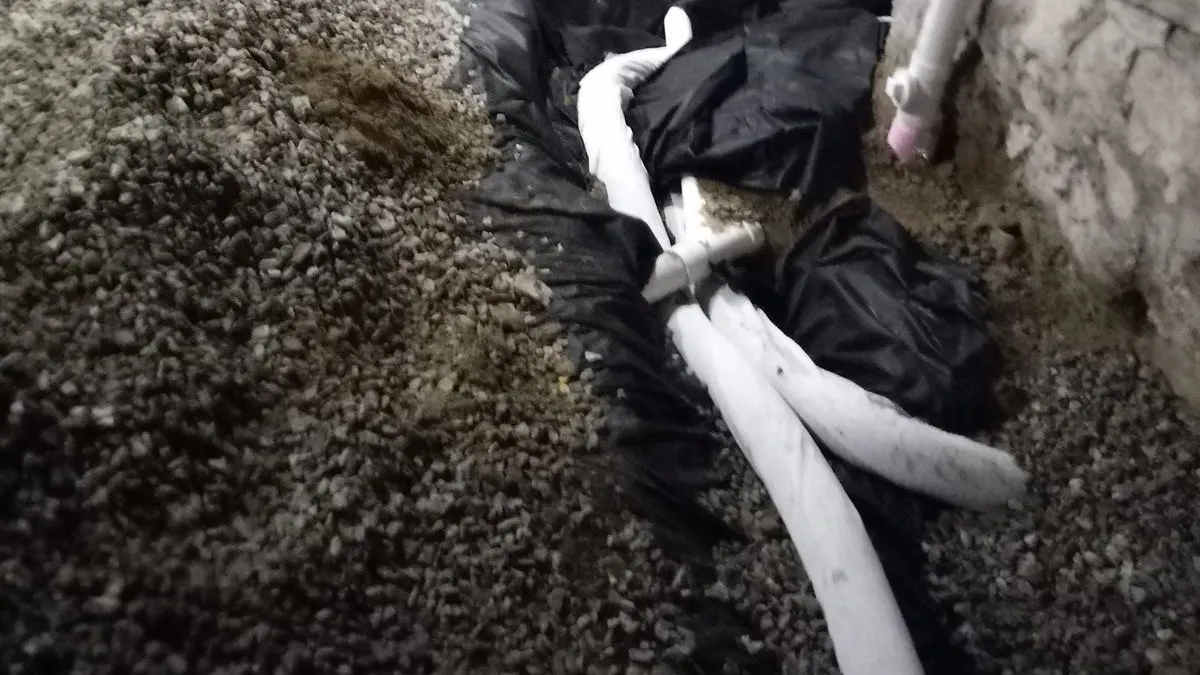
- We dig a trench down to the footing level and lay perforated drain pipe in clean crushed stone, wrapped to keep silt out.
- A dimpled membrane goes along the base of the wall so water that seeps through the wall runs down into the drain instead of across the floor.
- The drain is pitched to a sump pit with a sump pump that discharges the water outside, away from the house.
- We pour new concrete over the trench so the floor is finished and level again.
Because the drain sits at the lowest point around the footing, it lowers the water level under the whole slab. Water stops coming up through the middle of the floor even though the drain runs only along the edges.
When do you need more than a drain?
Sometimes the floor water is only part of the picture. If the foundation wall itself has cracks that leak, those may need foundation crack injection. Fieldstone and cobblestone walls with loose or missing mortar may need cobblestone basement repair before a drain can do its job. And if water is getting in through an old bulkhead, the bulkhead may need replacing. A proper assessment looks at all of these together so you are not fixing one leak only to find the next one. The same groundwater can freeze under an attached garage, too; our article on why garage floors heave in winter covers that side of it.
This is the point where it makes sense to bring in a contractor. Diagnosing where water enters, sizing a sump for your water table, and cutting and re-pouring a basement floor are not small jobs, and getting the pitch or the discharge wrong can leave you with a pump that runs constantly or water that freezes at the outlet. We offer a free on-site assessment in Milton and the surrounding towns, and winter is a good time for it, because we can see exactly where the water is coming in.
If you are seeing water on your basement floor this winter, a short visit is usually enough to tell you where it is coming from and what it will take to stop it. Concrete Solutions & Waterproofing serves homeowners, condo associations and facility managers across Eastern Massachusetts, Rhode Island and Southern New Hampshire.
Key takeaways
- Water coming up through a basement floor is usually groundwater under pressure, not a plumbing leak.
- In Eastern Massachusetts it peaks during winter thaws and heavy rain on top of snow, when the water table rises fast.
- Older Milton homes with fieldstone foundations and slabs poured on bare soil are especially prone to it.
- Floor sealers do not hold back water under pressure. An interior perimeter drain and sump pump relieve the pressure and carry the water out.
- A free assessment can tell you whether you also need wall crack repair, fieldstone repointing or bulkhead work.